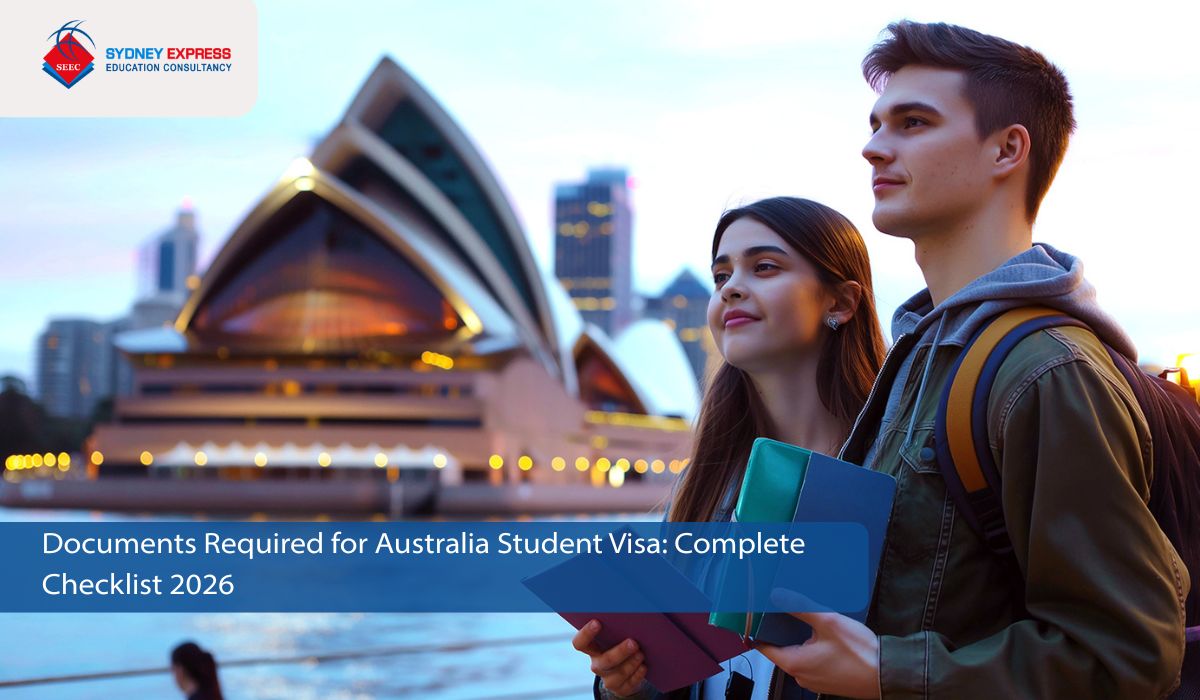
If you're planning to study in Australia this year, knowing exactly which documents are required for Australia student visa applications can mean a real difference. This helps ensure a smooth application process and reduces the…
If you’re planning to study in Australia this year, knowing exactly which documents are required for Australia student visa applications can mean a real difference. This helps ensure a smooth application process and reduces the risk of delays, frustration, and rejection. With 2026 bringing tighter security, stricter financial requirements, and placing Nepal at level 3 evidence due to high risk, the strictest among all categories, having proper documentation is essential.
This complete checklist covers every document you need for the Australia Student Visa (Subclass 500). No matter whether you’re based in Kathmandu, Pokhara, or anywhere else across the country, this guide will provide you with the information on which documents must be prepared, how to format them, and what common mistakes to avoid.
What Is the Australia Student Visa (Subclass 500)?
Australia Student Visa (Subclass 500) is the primary visa for international students who want to study full-time at a CRICOS-registered education provider in Australia. This visa allows eligible students to take up part-time jobs while studying and also travel in and out of Australia during their study period.
It covers a wide range of study levels, ranging from undergraduate and postgraduate degrees, vocational education and training (VET), English language courses (ELICOS), and school programs. To be successful in your application for the Australia Student Visa (Subclass 500), there are certain requirements that have to be fulfilled.
Complete Documents Required for an Australian Student Visa in 2026
It is very important to have all the necessary documents before applying for a visa. Below are some of the documents required for an Australian student visa in 2026.
1. Personal Identification Documents
Your identity documents are the foundation of your application. You have to ensure that your documents are up-to-date, valid, and consistent across all paperwork.
- Valid Passport – Your passport should be valid for the period you plan to stay in Australia. Ensure that you update your passport if it is about to expire
- Passport-size photos – Recent, good-quality, and meeting Australian immigration photo requirements
- Birth certificate – Your official birth certificate from the ward or municipality office where you are registered
- Nepali citizenship certificate/National ID – This is your main national identification document
2. Visa Application Form
All forms need to be submitted electronically via ImmiAccount, which is the portal operated by the Australian Department of Home Affairs. There is no paper form, as the form is filled out digitally within the website.
Points to note while filling the form:
- You need to create an account on ImmiAccount before you proceed with the form.
- Ensure all your documents are ready in digital format.
- Do not leave any space unattended since mistakes in your name, DOB (Date of Birth), and passport numbers will make the process longer.
- Submit an application.
Note: During the submission of the application form, you will be required to pay an application fee in AUD.
3. Confirmation of Enrolment (CoE)
The Confirmation of Enrollment (CoE) is also referred to as an eCoE (electronic CoE), an official document provided by an Australian educational institution once you accept the offer and pay the necessary deposit for tuition.
The CoE includes:
- Course details
- Institution details
- Length of the course
- Student’s enrolment status
You will not be able to apply for the student visa without the CoE.
4. Financial Documents
Financial documents are the most important among all documents needed for an Australian student visa. It should demonstrate that students can financially support themselves during their studies.
Financial evidence may include:
- Personal Bank statements
- Education loan approval letters
- Fixed deposit certificates
- Sponsorship documents
- Income records
The purpose of these documents is to show that you can cover:
- Tuition fees
- Living expenses
- Travel expenses
Understanding the cost of living in Australia for international students can help you estimate the funds you may need to demonstrate during the visa application process.
5. No Objection Certificate (NOC)
Nepalese students usually need a No Objection Certificate (NOC) from the Ministry of Education before transferring funds for international studies. The NOC serves as official approval from the Nepalese government for students pursuing education abroad.
The requirements for applying for the NOC are usually:
- A valid passport
- Confirmation of Enrolment (CoE) or offer letter from the Australian institution
- Academic certificates and transcripts
- Citizenship certificate or National ID
It is advisable to apply for an NOC immediately upon receipt of your Confirmation of Enrollment (CoE), since this document is essential for making foreign education payments from Nepalese banks. Many students seek professional guidance during this stage to ensure all academic and financial documents are prepared correctly. Working with a trusted education consultancy for Australia can help you avoid mistakes and navigate the application process with confidence.
6. English Language Proficiency Proof
English language proficiency proof is an important documentation criterion for Australian student visa applications.
Acceptable English tests in 2026:
- IELTS – This test is most widely accepted by students
- PTE – growing popularity as it is faster than IELTS and conducted through computers
- TOEFL iBT
- Cambridge English Test (CAE/C2)
General score benchmarks (varies by institution and course):
|
Test |
Typical Minimum Score |
| IELTS Academic | 5.5–6.5 overall |
| PTE Academic | 42–58 |
| TOEFL iBT | 46–79 |
| Cambridge CAE | 162–176 |
7. Genuine Student (GS) Statement
There is no other single piece of documentation that will either make or break your chances of getting an Australian student visa than the Genuine Student (GS). This statement helps Australian authorities assess whether your primary intention is to study in Australia.
The GS requirement is completed through short written responses within your ImmiAccount application form. You must clearly and honestly address:
- Why did you choose to study in Australia
- Why did you choose this particular course and institution
- How the course aligns with your future career goals
- Your study background and future plans
A well-written GS statement can strengthen your visa application significantly.
8. Academic Transcripts and Certificates
Your previous academic history is a core part of the documents required for Australia student visa. This record assists the visa officers in verifying whether the chosen course is the appropriate choice for furthering education and career plans.
These documents may include:
- Mark Sheet and Certificate for SEE (Secondary Education Examination)
- NEB (+2) Transcript and Certificates for undergraduate applicants.
- Bachelor’s transcript and provisional/final certificate for graduate applicants.
- Transcripts from each year of study, not just the final year
9. Overseas Student Health Cover (OSHC)
All international students in Australia must take OSHC (Overseas Student Health Cover) during their stay there. It is a health insurance policy specifically designed for international students.
OSHC will help cover:
- Medical treatment
- Hospital costs
- Emergency healthcare services
Proof of OSHC is an important part of the documents required for Australia student visa applications.
10. Police Clearance Certificate
Applicant aged 16 or above, you will most likely be required to submit a police clearance certificate. This can be obtained from the Nepal Police Headquarters in Naxal, Kathmandu.
The certificate shows that you do not have any criminal history in Nepal. Make sure that there is enough time for the process to be completed, taking between 7 to 14 days usually. It is necessary that the certificate is not older than 3-6 months from the date of the application.
11. Additional Documents (Case-Specific)
Based on your circumstances, you would additionally require the following documents for Australia student visa application:
- Traveling With Dependent Partner
-
- Marriage certificate, which should be issued by your municipal authority/ward office in Nepal, and have an English certified translation if written in Nepali
- Birth certificates of the dependent, issued by the respective ward office, along with an English-certified translation
- Evidence of the genuine relationship that exists between you and your partner, such as joint pictures, proof of cohabitation, and financial documents
- Scholarship Holders
- An official letter from the granting body regarding the amount of scholarship, its tenure, and the conditions of the scholarship
Common Mistakes to Avoid When Preparing Student Visa Documents
Many student visa problems arise from minor errors that could have easily been avoided.
Some typical problems include:
- Incomplete documentation – Inadequate information will lead to delays in the processing of applications.
- Expired Passport – It is important to ensure that your passport is valid while applying for a visa.
- Inconsistent Information – Your information should be consistent in all of the documents provided, such as:
- Name
- Date of Birth
- Passport number
- Weak Financial Statements – Inadequate financial statements will cause difficulties in evaluation.
- Weak genuine student statement – The statement prepared for this purpose should clearly articulate your intentions.
Review all documents carefully before submission to reduce the risk of complications.
Conclusion
Preparing the documents required for Australia student visa applications is one of the most important steps toward studying in Australia. But for Nepali students, it requires meticulous planning and complete documentation. From your passport and Confirmation of Enrolment (CoE) to financial evidence, health insurance, and academic records, every document plays a vital role in supporting your application.
It is recommended that the student start preparing their application three to four months prior to the proposed intake date. This means that all the required documents must be properly notarized and translated. Students should establish a clean and honest financial history, and they should write a proper GS statement that genuinely reflects who they are and what they want to achieve. In doing so, you will have more chances of a smooth visa application process and timely approval.
If you need expert assistance with university applications, visa documentation, Genuine Student (GS) statements, or course selection, our team can help simplify the process and guide you every step of the way. Contact Sydney Express today for personalised support with your Australian student visa journey.
Frequently Asked Questions (FAQs)
Q: Is IELTS mandatory for an Australian Student Visa?
A: No, it depends because different English proficiency tests can be taken based on institutional and visa requirements.
Q: How much money do I need to show as a Nepali student applying for an Australian student visa in 2026?
A: The required financial capacity varies depending on tuition and accommodation costs, among other factors.
Q: Is a police clearance certificate required for a Nepali student visa applicant?
A: Yes. If you are a Nepali applicant who is 16 years or older, it is mandatory for you to get a police clearance certificate from the Nepal Police Headquarters at Naxal, Kathmandu. The processing time for this document takes about 7-14 working days.
Q: Do I need health insurance for an Australian Student Visa?
A: Yes. Overseas Student Health Cover (OSHC) is generally required for international students.
Q: Can my parents sponsor me to study in Australia?
A: Yes, parents can sponsor you for your education in Australia if they can provide sufficient financial and supporting documents.