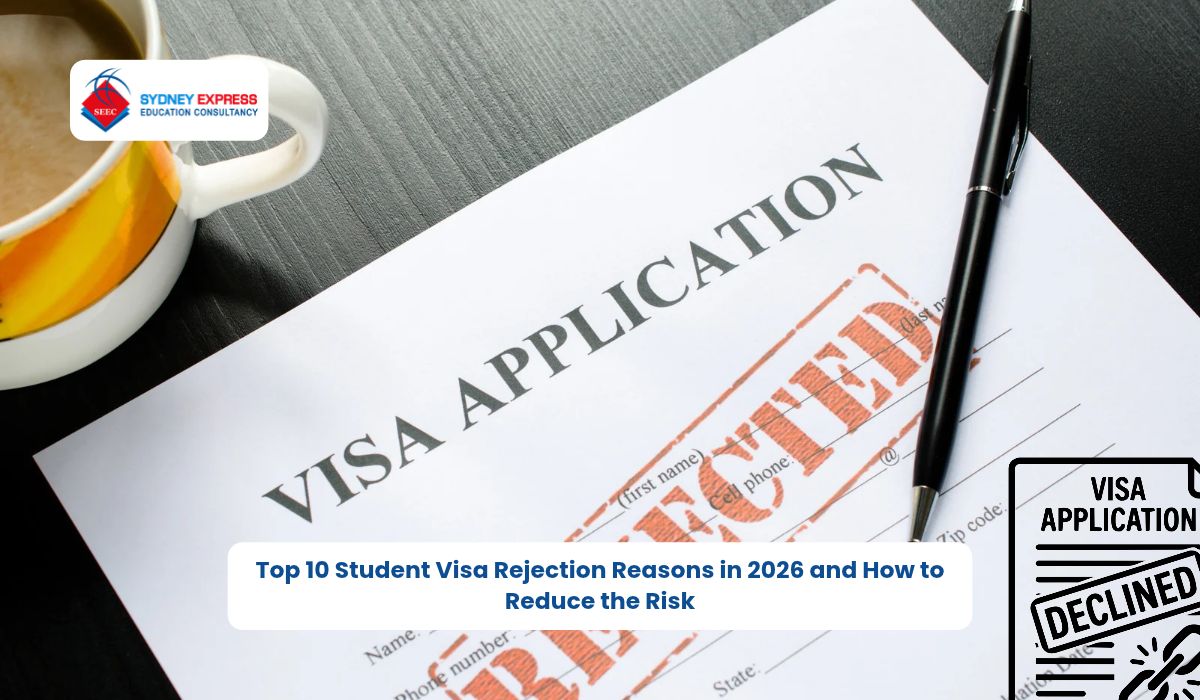
A student visa rejection can delay your study plans, increase costs, and require you to reassess your application. However, a visa refusal is not always caused by one obvious mistake. Visa officers may consider your…
A student visa rejection can delay your study plans, increase costs, and require you to reassess your application. However, a visa refusal is not always caused by one obvious mistake. Visa officers may consider your financial evidence, documents, study plans, eligibility, immigration history, and the overall consistency of your application.
The exact requirements also depend on your destination. Australia, Canada, the UK, and the USA have different student visa or study permit rules, so you shouldn’t simply copy an application prepared for one country to another.
If you plan to study abroad, understanding common student visa rejection reasons can help you identify potential weaknesses before submitting your application. Below are 10 common reasons that can contribute to student visa refusal and what applicants can do to address them.
Why Student Visas Get Rejected in 2026
1. Insufficient or Unclear Financial Evidence
Financial evidence must show that you can meet the costs of studying abroad and that the money available to you is genuine, accessible, and properly supported.
The amount required and the documents accepted depend on your destination, visa category, and circumstances. Problems may arise when:
- Funds do not meet the applicable financial requirement
- Large or unexplained deposits appear in an account
- The source of funds or sponsor support is unclear
- Financial information conflicts with the application or supporting documents
If a family member is funding your studies, provide evidence of the relationship, the sponsor’s financial circumstances, and the source of the funds where required. You should also be able to explain how relevant study costs will be covered.
2. Incomplete or Incorrect Visa Documents
Student visa document requirements depend on the applicant’s circumstances. An application can contain strong financial evidence and a genuine study plan but still face problems if required documents are missing, inaccurate, or inconsistent. Missing, inaccurate, or inconsistent documents can make it difficult for the immigration authority to assess whether you meet the applicable requirements.
Errors can include:
- Incorrect names or dates
- Missing academic documents
- Incomplete financial evidence
- Missing admission-related documents
- Documents that do not meet translation requirements
- Information entered incorrectly on application forms
- Documents that cannot be verified
Before submitting an application, review the relevant official document checklist carefully and make sure the information across your forms and supporting documents matches.
3. A Weak or Unclear Study Plan
A clear study plan is an important part of a student visa application. Visa officers may want to understand why you have chosen a particular course, how it connects with your academic or professional background, and how it supports your future plans.
Problems may arise when:
- The reason for choosing the course is unclear or too general
- The proposed course does not appear to match your previous education or work experience
- A major change in study direction is not properly explained
- The choice of institution or destination is not supported by a clear reason
- Future study or career plans are unrealistic, inconsistent, or unrelated to the proposed course
Avoid relying on generic statements such as “I want a better future” or “I want to study in a developed country.” Instead, explain why the course is suitable for you, why you selected the institution and destination, and how the qualification fits into your longer-term plans.
4. Inconsistent Information Across the Application
Consistency matters across the entire application. Information in your application form, academic records, financial documents, study plan, and interview responses should not contradict one another.
For example, questions can arise if:
- Your stated study plan conflicts with your academic history
- Your financial information does not match your supporting documents
- Your application gives different dates for education or employment
- Your interview answers significantly contradict your written application
- Previous immigration history has been omitted or inaccurately described
An inconsistency does not automatically mean a visa will be refused. Its significance depends on what the discrepancy is and the circumstances surrounding it. However, unexplained differences can make an application more difficult to assess and can require additional clarification.
5. Poor Preparation for Questions or Further Information Requests
Depending on the destination and application, students may be interviewed or asked to provide additional information. Applicants should understand their course, institution, funding arrangements, and study plans well enough to explain them clearly. Memorised or contradictory answers can create concerns when they do not match the written application.
Common problems include:
- Not understanding the chosen course or institution
- Being unable to explain funding clearly
- Giving memorized or contradictory answers
- Providing answers that conflict with submitted documents
Prepare by reviewing your application carefully and making sure you can explain the information you have provided. Focus on understanding your own circumstances rather than memorising answers.
6. Unexplained Academic Gaps or Academic History
An academic gap does not automatically result in student visa refusal. The relevant issue is an unexplained period between studies, a significant change in academic direction, or a pattern of weak academic performance that may lead to questions about your proposed study.
For example, an applicant who completed a qualification several years ago and is now applying for a substantially different course may have spent time working, preparing for another qualification, dealing with personal circumstances, or pursuing other legitimate activities. Those circumstances can be explained with appropriate information and evidence where relevant.
7. Failing to Meet Country-Specific Eligibility Requirements
Student visa requirements differ by country, visa category, and applicant circumstances. For example, USA student visa requirements are different from the requirements for Australia, Canada, or the UK. Meeting the requirements for one destination does not automatically mean you qualify for another.
Australia, Canada, the UK, and the USA each have their own eligibility criteria and application requirements. Applicants should therefore check the current requirements for their specific destination and visa category before applying.
Failing to meet an applicable requirement can affect the outcome of an application, even when other parts of the application are strong. Before submitting your application, make sure you understand the requirements that apply to your circumstances and have addressed them appropriately.
8. Previous Visa Refusal or Unclear Immigration History
A previous visa refusal does not necessarily mean that a future student visa application will be rejected. However, previous visa decisions and immigration history may be relevant when assessing a new application.
Problems may arise when:
- A previous visa refusal is not disclosed when required
- The concerns raised in an earlier decision have not been addressed
- There are unexplained visa refusals, cancellations, or overstays
- Previous immigration information conflicts with the new application
- The applicant has a history of non-compliance with visa conditions
The important issue is whether the new application accurately addresses the concerns raised in the previous decision. If there was a previous refusal, review the reasons carefully and make sure any relevant changes or supporting evidence are clearly explained.
Submitting another application without addressing a material issue may leave the underlying problem unresolved.
9. Failure to Meet Health, Character, or Other Requirements
Student visa eligibility is not limited to academic and financial requirements. Depending on the destination and your circumstances, you may also need to satisfy health, character, or other admissibility requirements.
Failing to meet an applicable requirement can affect the outcome of a visa application, even when the applicant otherwise meets the academic and financial criteria. Make sure you understand the requirements that apply to your specific destination and circumstances before applying.
10. False, Misleading, or Unverifiable Information
Providing inaccurate information or false documents can have much more serious consequences than simply leaving out a supporting document.
Examples can include:
- Altered financial documents
- False academic records
- Misrepresented employment history
- Incorrect statements about previous visa applications
- Misleading information about personal circumstances
- Providing information that cannot be verified
- Using inaccurate information prepared by someone else
Immigration authorities may take serious action where an applicant provides false, misleading, or unverifiable information. An application should reflect the applicant’s actual circumstances. If a document is unavailable or a particular fact needs explanation, it is better to address the issue through the appropriate process than to create evidence that does not exist.
How to Reduce the Risk of Student Visa Rejection
No document, statement, or preparation method guarantees a visa grant. The practical goal is to submit an application that is complete, accurate, and supported by evidence relevant to your circumstances.
1. Check the Current Student Visa Requirements
Requirements can change, so check the current official guidance for your destination, visa category, course, institution, financial evidence, language requirements, health or character requirements, and supporting documents.
Always check the current requirements for:
- Your destination
- Your visa category
- Your course and institution
- Financial evidence
- English language requirements
- Health or character requirements
- Required forms and supporting documents
2. Prepare Your Financial Evidence Carefully
Review your financial evidence against the current requirements for your destination. Make sure the source of funds is clear, supporting documents are available, and the information matches the rest of your application.
3. Make Sure Your Application Is Consistent
Before submission, compare your passport details, academic and employment history, financial information, course details, study-purpose responses, and previous visa information for consistency.
Check both small administrative errors and significant inconsistencies before submission.
4. Prepare for Questions About Your Study Plans
Be ready to explain your course, provider, funding, previous education, and plans in your own words. If your destination involves an interview or further information request, your answers should remain consistent with your written application.
5. Submit Genuine and Accurate Information
Make sure every document and statement reflects your actual circumstances. If there is an academic gap, complex financial arrangement, or previous refusal, explain it accurately and provide supporting evidence where required
What to Do After Student Visa Rejection
Receiving a student visa refusal does not necessarily mean you cannot apply again. Before submitting another application, identify what led to the decision and determine what, if anything, needs to change.
1. Read the refusal letter carefully
Review the reasons given for the refusal and identify the specific concerns raised about your application.
2. Check the information and documents you submitted
Review your application, supporting documents, financial information, study details, and other relevant evidence to see whether they adequately addressed the concerns raised.
3. Look for additional decision information
Depending on the destination, additional decision information or review options may be available. Check the relevant immigration authority’s current guidance to understand what applies to your case.
4. Identify what needs to change or be clarified
Consider whether there are gaps, inconsistencies, missing evidence, or changes in your circumstances that need to be addressed before making another application.
5. Check your available options.
Depending on the visa system and the reason for refusal, you may be able to reapply or use another permitted review or appeal process. Check the current rules for your destination before deciding what to do next.
6. Prepare the next application carefully.
If you reapply, make sure the new application addresses the relevant concerns rather than simply repeating the previous submission. Provide clear and appropriate supporting evidence where required.
Can You Reapply After a Student Visa Rejection?
In many cases, a student visa refusal does not permanently prevent you from applying again. However, whether you can reapply and what requirements apply will depend on the destination, visa category, and reason for the refusal.
A student visa reapplication should not simply repeat the previous application. The new application should address the concerns that led to the earlier refusal and reflect any relevant changes in your circumstances or supporting evidence.
Simply waiting for some time before submitting the same application may not resolve the issue. Before reapplying, check the current rules for your destination and make sure you understand what needs to be addressed in the new application.
Conclusion
Student visa requirements differ between Australia, Canada, the UK, and the USA. Before applying, check the current requirements for your destination and review your financial evidence, documents, study plans, academic history, and immigration information carefully.
If you are concerned about your application, Sydney Express helps Nepali students with course selection, admissions, and student visa guidance for Australia, Canada, the UK, and the USA.
Frequently Asked Questions (FAQs)
Q: Can I apply again after a student visa rejection?
A: You may be able to apply again, depending on the destination, visa category, and reason for refusal. Before reapplying, review the refusal decision and address the concerns identified in the previous application rather than submitting the same application again.
Q: Does a previous visa refusal affect a new application?
A: A previous refusal may be relevant to a new visa application, particularly if the concerns raised in the earlier decision remain unresolved. Disclose previous immigration decisions when required and make sure the new application accurately explains any relevant changes or supporting evidence.
Q: What should I do after receiving a visa refusal letter?
A: Read the refusal letter carefully and identify the specific reasons for the decision. Review the information and documents submitted, determine what needs to be addressed, and check the current rules for your destination to understand whether reapplication, review, or another permitted option is available.
Q: Can missing documents cause student visa rejection?
A: Yes, missing or incorrect documents can create problems when an application requires specific evidence. The documents required vary by destination, visa category, and applicant circumstances. Check the current document requirements for your application and make sure the information provided is complete and consistent.
Q: Does student visa rejection mean I cannot study abroad?
A: No. A student visa refusal does not necessarily mean you cannot study abroad in the future. Depending on the circumstances, you may be able to address the issues identified in the refusal and apply again or consider another destination or study option.