If you are planning to study abroad from Nepal, choosing between IELTS and PTE can be an important part of your application process. Both are recognized English proficiency tests, but they differ in test format, speaking…
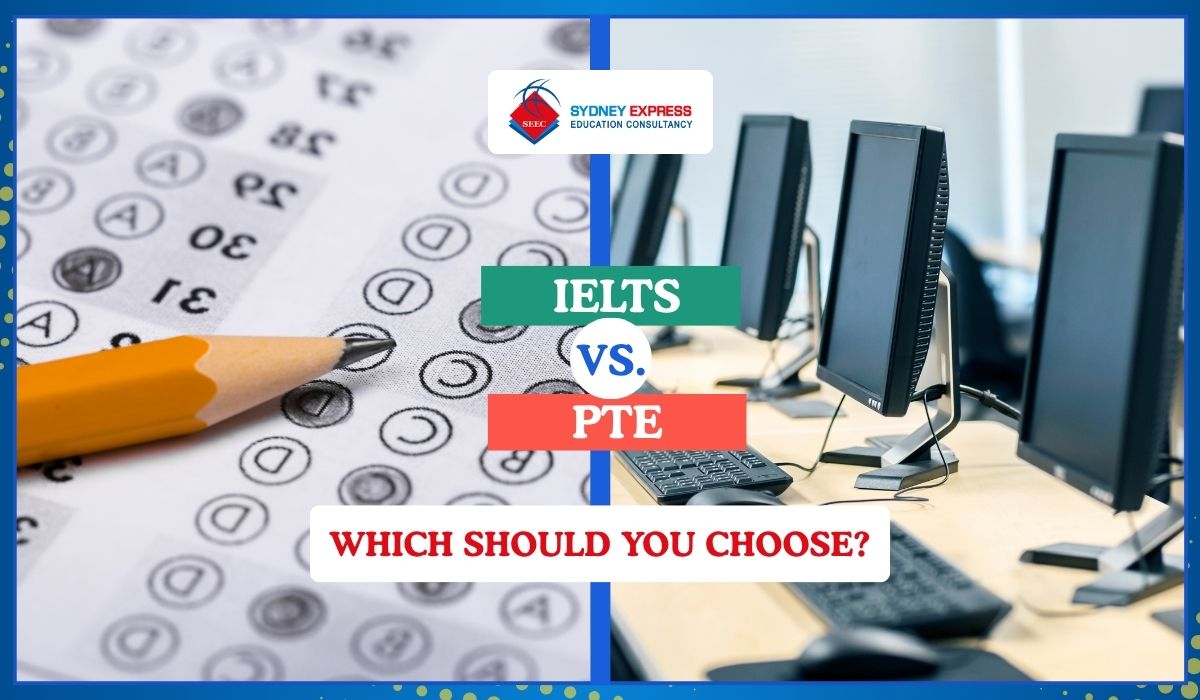
If you are planning to study abroad from Nepal, choosing between IELTS and PTE can be an important part of your application process. Both are recognized English proficiency tests, but they differ in test format, speaking assessment, scoring, question types, and result times.
So, which is better: IELTS or PTE? The answer depends on your target university and destination, the score you need, your strengths in English, and how comfortable you are with computer-based testing. IELTS may suit students who prefer speaking directly with an examiner, while PTE may appeal to those who prefer a fully computer-based test.
This guide compares IELTS and PTE for Nepali students, including their test formats, difficulty, score comparison, results, and acceptance for studying abroad, to help you choose the test that best fits your study plans.
IELTS vs PTE: What is the Difference?
IELTS Academic and PTE Academic both assess your English ability across listening, reading, writing, and speaking. The biggest difference is how you complete the test.
| Features | IELTS | PTE |
| Test format | Computer-based (paper being phased out from June 2026) | Fully computer-based |
| Skills tested | Listening, Reading, Speaking, Writing | Listening, Reading, Speaking, Writing |
| Speaking | Face-to-face with an examiner | Recorded through a computer |
| Assessment | Human examiners assess Speaking and Writing | Computer-based automated scoring |
| Score scale | 0-9 | 10-90 |
| Results | Generally available within a few days for IELTS on Computer | Around 48 hours |
| Best suited to | Students comfortable with face-to-face speaking and conventional writing tasks | Students comfortable with typing, microphones, and timed computer tasks |
While both IELTS and PTE assess the same four fundamental skills in English, the way those skills are assessed is quite different. Unlike the IELTS test, which assesses the speaking skill through a face-to-face test conducted by an examiner, the PTE test is fully computer-based, with automated scoring. Knowing these distinctions can help you choose a format that suits your strengths before you book your English proficiency test.
IELTS vs. PTE: Which Test Is Easier?
The answer to “IELTS vs. PTE: Which is easier?” depends on how comfortable you are with each test format. Neither the IELTS test nor the PTE test is automatically easier for every student. Your speaking style, writing ability, reading speed, listening skills, and comfort with computer-based testing can all affect your performance.
1. Comparing Reading Section
Both IELTS and PTE require excellent reading skills, vocabulary, and time management; however, the format of the questions is not the same. IELTS Academic Reading includes reading a passage and then answering various types of questions where students have to extract information, comprehend the idea, and analyze the passage.
PTE Reading comprises various computer-based activities such as multiple-choice questions, reordering paragraphs, and fill-in-the-blanks. One task also combines reading and writing skills.
This is why IELTS test practice and PTE test practice should focus on the actual question types rather than simply completing random English exercises.
2. Comparing the Speaking Section
Speaking is one of the biggest differences between the two tests. In IELTS, the speaking is a one-on-one interview with an examiner. You need to respond to questions, explain your ideas, and communicate naturally in real time.
PTE Academic takes a different approach. It is entirely computer-based, where you speak into a microphone, and AI evaluates pronunciation, stress, fluency, rhythm, and oral communication across integrated speaking tests such as the following:
- Read Aloud
- Repeat Sentence
- Describe Image
- Re-tell Lecture
3. Comparing Writing Section
IELTS Academic includes two writing tasks, requiring you to develop and structure your thoughts logically and demonstrate appropriate grammar, vocabulary, and coherence.
PTE Academic combines speaking and writing tasks, with several question types requiring written and spoken responses. Because PTE is computer-based, you also need to be comfortable typing your answers and switching between different task formats.
4. Comparing Listening Section
IELTS and PTE both assess your ability to understand spoken English, but the way you respond is different.
In IELTS Listening, you listen to recordings and answer questions based on information, opinions, and key details.
PTE Listening includes several computer-based question types. Audio or video clips generally play automatically and are heard once, with tasks including summarizing spoken text, identifying correct information, filling gaps, and writing from dictation. You can take notes during the listening section.
IELTS May Suit You If:
- You communicate comfortably in face-to-face conversations.
- You prefer conventional essay-writing tasks.
- You don’t mind speaking directly with an examiner.
- You prefer clearly separated test sections.
PTE May Suit You If:
- You’re comfortable speaking into a microphone.
- You can type comfortably and accurately.
- You prefer a fully computer-based test.
- You’re comfortable with integrated question types.
- You value a faster result turnaround.
IELTS and PTE Score Comparison
Understanding the difference between an IELTS test band score and a PTE score is important. The necessary English proficiency score will depend on your university, course, and study destination. Some institutions may also set minimum scores for individual skills, so checking the exact requirements is essential before you book either test.
IELTS Band Score vs PTE Score
The IELTS test uses a 0–9 band scale, with an overall band score and separate scores for listening, reading, writing, and speaking. PTE Academic uses a 10–90 scale and provides an overall score as well as individual scores for the four communicative skills.
| IELTS Academic | PTE Academic |
| 5.0 | 31-38 |
| 5.5 | 39-46 |
| 6.0 | 47-54 |
| 6.5 | 55-62 |
| 7.0 | 63-70 |
| 7.5 | 71-78 |
| 8.0 | 79-85 |
| 8.5 | 86-89 |
| 9.0 | 90 |
Use this as a guide and not as an assurance—this is a research-driven concordance In case you have the IELTS band score that you should attain, use this as an IELTS test calculator to get the corresponding PTE score that you need. Remember, always double-check the exact score that your desired university or visa requires because it is up to them to determine the minimum score they require.
Which Is Better for Studying Abroad: IELTS or PTE?
Both IELTS and PTE Academic are accepted by universities and visa authorities across Australia, Canada, the USA, and the UK, but score requirements and accepted formats may be different from country to institution.
- Australia: Both tests are accepted for university admission and for student visa applications. If you are planning to study in Australia, always check the current Australian student visa requirements and your university’s English-language requirements before choosing a test.
- Canada: Universities accept both IELTS Academic and PTE Academic. However, PTE Core is required for certain Canadian immigration purposes.
- USA: Most universities accept both. Acceptance varies by university and programs. Check the individual institution before applying.
- UK: Both are legitimate options for university admission. However, PTE Academic UKVI is the relevant version for certain UK visa purposes, so don’t treat ordinary PTE Academic and UKVI requirements as interchangeable.
IELTS vs. PTE: Which Test Results are Faster?
For many Nepali students, result time can be as important as the difficulty of the exam. If you have a university application deadline approaching, getting your IELTS test results or PTE test results quickly can make a practical difference.
- PTE results are available in approximately 48 hours.
- IELTS exam on computer: you can view the results in 3-5 days
- Paper-based IELTS tests usually take 13 days.
Along with the IELTS test result and PTE test result, consider how much preparation time you need, when the dates are available in Nepal, and how quickly you may need to submit your English proficiency score. This can help you plan your IELTS test booking or PTE test booking around your application timeline rather than making a last-minute decision.
If you’re still unsure which test to choose, an education consultancy in Nepal can help you compare your options based on your destination, university requirements, target score, and application timeline.
Conclusion
The IELTS vs. PTE decision ultimately comes down to which test fits your study plans, strengths, and target score. IELTS may suit students who prefer a live speaking assessment, while PTE can be a good option for those who are comfortable with a fully computer-based English proficiency test. Before registering, check your university’s accepted tests and score requirements, then consider the IELTS test format, PTE Academic scoring, preparation time, and result timeline. Taking a few IELTS test practice questions and PTE test practice tasks can also help you identify which exam feels more suitable before you commit to your test date.